Will AI Replace Immigration Advisers?
It almost feels normal to start off your blog post with a disclaimer that this was not written by AI, but by a human being, tapping away at a keyboard (which it was). I can however appreciate the potential irony in a post about AI replacing my job, being written by…AI. When I last wrote about this topic, AI was a website that people used to help them answer questions - in a relatively short space of time, AI has developed its own social network, is producing videos indistinguishable from live action and occupies 75% of the online influence marketing selling products. It has literally worked its way in to almost everything we do and continues to do so, day by day, hour by hour. In fact by the time I have written this, something new will have surfaced in the AI space.
Naturally, all of this technological development has lead myself and others in the industry to query whether AI might be coming for our jobs (as plenty of people who work with information and advice might also be contemplating). I might be making a pretty bold claim, but AI will not replace immigration advisers. It will replace parts of what we do, but not the parts that matter most.
However, the bigger question is not necessarily who will or won’t lose their jobs (that may of course happen, and in some industries already is) but how AI is going to change the nature of almost everything we do. For those regular day to day tasks, AI is already assuming a pretty prominent role, but what about the other, one-off, life changing events (such as migrating)? My guess is that this will also change, and eventually AI will play a bigger role, but right now, it is actually creating far more problems in the immigration space than solutions.
The Value Of AI
I think most people are long past the point of arguing that AI is not going to catch on, or will never interfere in their patch and we probably all changed our minds about this pretty quickly. The internet took nearly twenty years to become mainstream - ChatGPT was rolled out only a few years ago and in that short space of time, AI has patched itself in everywhere. The technology is developing at a pace we are simply not used to (and perhaps are not able to control).
In that time, it has become more “intelligent” if that is the right word…moving away from the regular hallucinations and inability to count the times the letter ‘r’ appeared in the word strawberry to creating full length music videos that are impossible to distinguish from the real thing.
AI has given people access…
…to more information than they have ever had, explaining complex visa situations in seconds. However that hasn’t always resulted in increased chances of success.
AI as a tool, has opened doors for almost everyone and made a lot of what was traditionally very complex policy and rules, much easier for people to understand.
Traditionally, prospective migrants would rely on INZ to provide a summarised and simplified version of a complex visa category, via their website - giving them the nuts and bolts. The problem with these descriptions were that they lacked all of that policy detail, or cross-referencing to other policies, which of course was often the difference between qualifying and being declined. People assumed they were eligible based on that simple, easy to digest website version, but failed because the actual rules underneath it all, contained far more complexity and potential places to fail.
AI has changed that playing field dramatically, as it can now read, review and produce reviews of the entire rule book, albeit still in a limited fashion. AI has given people a lot more clarity in terms of how the process works and revealed a lot of the vital detail that was previously overlooked.
In addition to this, AI has created the ability for applicants to respond to INZ, where there are concerns or issues, although this often leads to more problems being created. Creating a nice cover letter for your application with AI is one thing, however responding to a letter of concerns, expecting AI to be able to adequately address all those points is entirely another.
The fact remains however, that AI is changing the landscape for applicants and by consequence for advisers as well. Some of these changes are positive, with people having more access to relevant information, others not so much in that they have the potential to lead applicants down the wrong path. AI is fast. Mistakes in immigration are permanent.
The Pitfalls
One of the key things AI misses, and yet applicants are ultimately relying on, is how a certain set of rules might apply to them. The rules are standard, and there is only one version, but how they apply to each person will differ greatly. For example, you can have two potential applicants, same age, same qualifications, same job in New Zealand and same overall eligibility profile. AI will potentially explain how the process works and the pathway involved and yet what it won’t be able to determine (without specific prompting, requiring knowledge of the system itself) is the fact that each applicant’s nationality could change the timeline and overall process an applicant will take.
Rabbit holes
It is easy to go down a rabbit hole with AI, and without the correct inputs, the outcomes can be disastrous. and potentially very expensive.
If we assumed that both applicants were IT professionals, with high paying jobs in NZ and qualified for the Straight to Residence pathway, AI might rightly determine that the Green List, option exists and outline that plan, including pitfalls. However what it would fail to do (and I know because I tried it on the paid version of ChatGPT) is that certain countries, including China go through a separate National Security check. So if this applicant was a UK national, residence would likely be processed within four to six weeks. For a Chinese applicant, it would be potentially four to six months. That would then mean the Chinese applicant would need to include a Work Visa in their strategy where the UK national wouldn’t. That is a fairly sizeable difference in approach.
This missed information is pretty rife, because its often not openly published by INZ. However where information is missed more often is the fact that applicants may not know everything they need to know, and tell AI to get the right answer. A medical condition declared incorrectly or not well explained might lead the answer from AI to be very different, not just in process, but in overall eligibility. An applicant’s relationship situation may not be easy to quantify, and yet could very well create issues in an application or be something that can be dealt with, despite seeming very complex.
There is a lot of subtlety within the visa process that AI simply cannot interpret or work out, often because it is information that either isn’t published online or is information not offered up by applicants feeding the system for an answer.
AI can give you a better surface level explanation of the process you might have to go through, but it lacks the ability to navigate what advisers do, day in and day out, by engaging with INZ and the myriad of systems and processes they use.
The Continuing Value Of Advisers
I love technology and I love how it has the potential to give us so many more options, and to ultimately improve our lives - equally I am wary of how that same technology can also create havoc. AI however is a new breed of technology and the sheer speed at which it has made itself ever-present is somewhat frightening. I use AI, not to write, but to give me ideas, to translate documents, to help analyse information and to speed up some of my manual processes - however every day, I still open, read and re-read the INZ Operations Manual.

Advice still counts
Interpreting the rules, applying them to real people and then understanding how the system works at all levels, is still well beyond the reach of AI.
I also encourage my staff (both younger than me) to do the same. We live in that operations manual and nothing substitutes for our ability to know where information lives inside of it, or how it all connects together.
We also have something that AI doesn’t and that is a working knowledge of the system and the people inside that system that spans decades. AI can read data and extrapolate a likely scenario, but it has not (at least not yet) filed applications, negotiated with case officers and managed client expectations throughout that process. That is why, when one of our recent clients was adamant that she only need to go Straight to Residence, we were able to encourage her and the employer to also pursue the Work Visa in the interim, knowing that her Residence application would take months to process, for reasons that AI simply could not fathom.
Beyond the technicalities, there are a few other things that AI can’t do, which we believe are crucial to the overall process. AI can’t calm your nerves, when it all feels too complex or you hit an obstacle and need to manage it. Having someone on board who can simply listen, and then rationally explain the best way forward is valuable currency when it comes to the visa process.
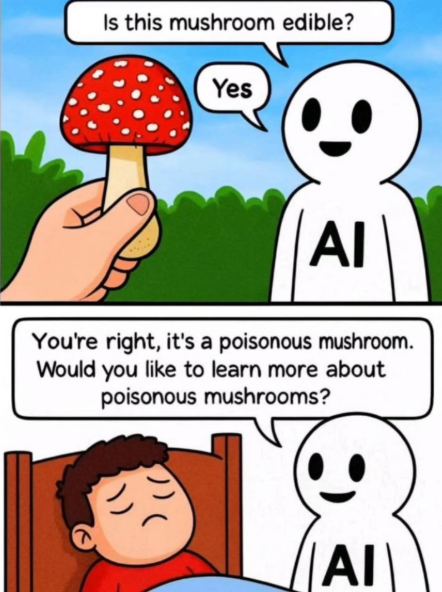
AI also can’t be held accountable for the outcome. The mushroom image on this page currently doing the rounds on the internet is a great example of this.
It is humorous, but it reflects a common AI issue - the increasing tendency to treat AI outputs as authoritative, rather than as a starting point for further enquiry. In low-stakes situations, that distinction does not matter. In higher-stakes environments, like moving your family to the other side of the planet - it matters a great deal.
Fewer situations, have stakes as high as those involved in the immigration process - for you and for your family. AI might suggest a course action, layout a plan and find you the cheapest airfares, however you have to live with the consequences.
Real People, Real Outcomes
Migration remains a human-centric process and I have no doubt that AI will gradually become more entrenched in that process. INZ has a section of the rule book that allows for decisions to be made by an “automated system” - that was introduced years ago, in a response to IT systems being used to action and finalise visas, but just as easily can accommodate the use of AI in making the actual final determination.
We have already seen INZ using AI to generate decision letters, helping officers to polish their written decisions - which is only a fine line from those same officers using AI to actually review documents and provide advice. In some ways that might bring us more consistency, but in others its a scary thought, given the importance those decisions hold.
AI will increasingly be used to verify, triage and manage applications and for clients, where AI is being increasingly used for every other task in daily life, AI will be relied on more and more heavily for increasingly important decisions.
However the complexity of the immigration process, or rather the complexity of the applicants situations that need to be measured against those rules, will still need human intuition, experience and instinct to be guided safely across the visa landscape. I am sure that my business will need to adjust and adapt to the world of AI, but I remain pretty comfortable that the involvement of myself and my team in helping clients will remain at the centre of it.
If AI has given you a plan, but you are not entirely convinced if it is the right one - get in touch. We provide real humans, dealing with real situations, and achieving real outcomes. AI might give you an answer. We will give you an outcome.
Until next week!