
SMC Rules Released. Finally.
The policy folks have had the hammers, saws and masking tape out again, and the new Skilled Migrant Category rules have now, finally, been released. They are not quite live yet - the official start date is 24 August 2026 - but we now have the final version of what is coming, and there is quite a bit for migrants, employers and advisers to get their heads around.
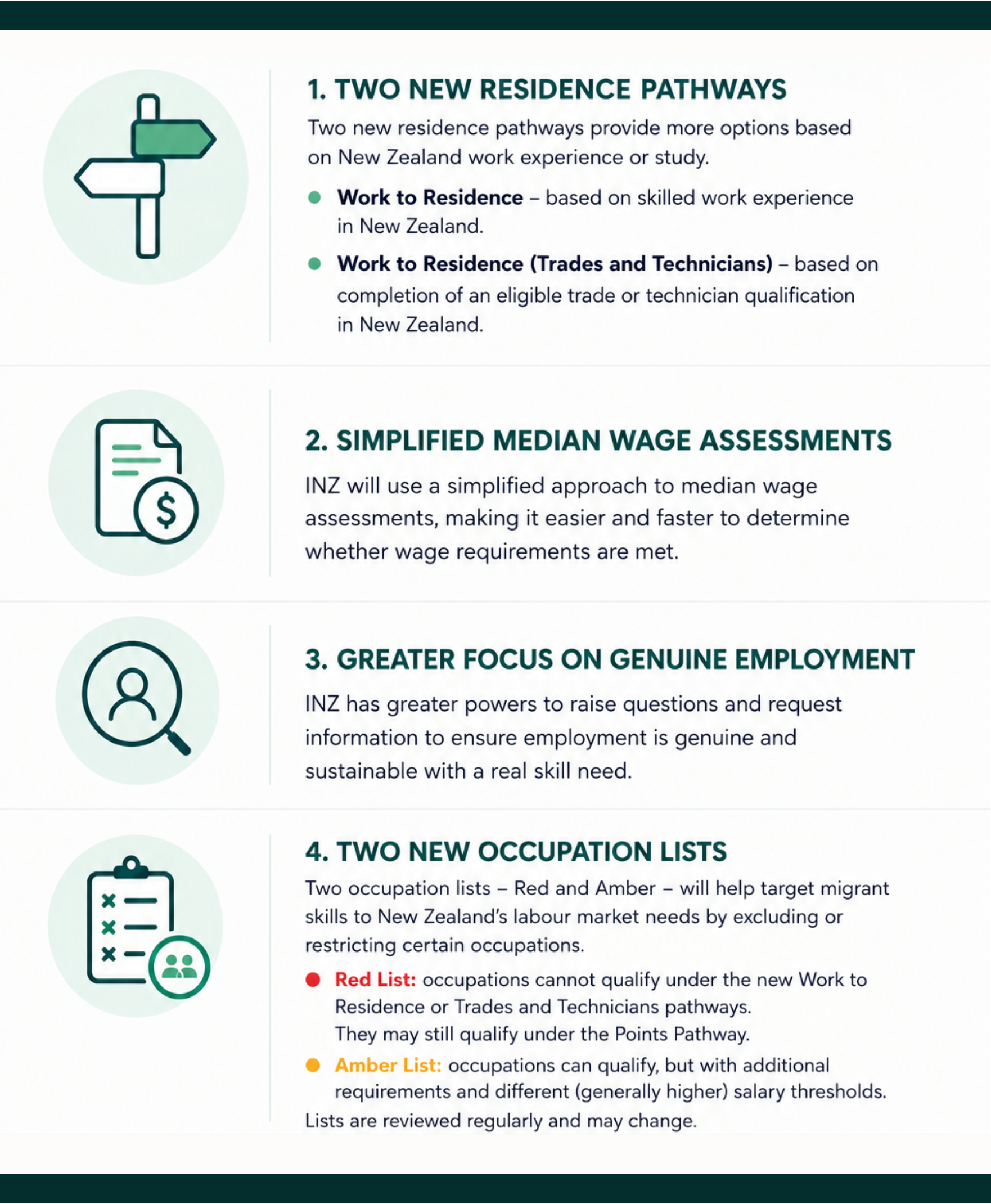
In broad terms, INZ is adding two new residence pathways alongside the existing points-based system: one for people with significant skilled work experience, and another for people in trade and technician roles. That sounds sensible enough, particularly given the long-standing need for experienced practical workers across New Zealand. But, as always, the detail matters. The new rules also introduce Red and Amber occupation lists, adjust how wage thresholds are assessed, and place a much stronger emphasis on whether employment is genuine, ongoing, and genuinely needed in New Zealand.
So while the framework looks simpler at first glance, this is not just a quick tidy-up. It is more of a patchy rebuild: new pathways, new exclusions, new evidence issues, and some important traps for people whose work history does not fit neatly into INZ’s preferred boxes. The rules may not take effect until August 2026, but anyone planning a residence strategy should be looking at them now, not later.
For months, we have had announcements, summaries, hints and policy breadcrumbs, however now we have the actual rules. Not the political version. Not the glossy version. The immigration instructions, and, as usual, the details are a lot more expansive and interesting, than the press releases and media sound bites that came before them.
The key message is that the Skilled Migrant Category is becoming broader, with new pathways being added. That is good news as it will allow more people, a realistic residence pathway, especially experienced workers and tradespeople who have previously been stuck in that frustrating space where New Zealand needed them, employed them, taxed them, and then made residence an unnecessarily difficult or impossible goal.
The new SMC is indeed more flexible, but also appears more technical. There is far more room for Immigration New Zealand to look behind the job title and ask whether the role is genuinely what it claims to be and a stronger emphasis on migrants being able to provide the “gold standard” in evidence.
While the changes are good for migrants and good for New Zealand overall, the one very obvious issue, is that this is more patchwork policy, with layers of detail and complexity added on top of the existing web of rules and instructions. This week’s article which is a bit lengthy (but for good reason), outlines what has changed, what opportunities exist and things that hopeful migrants still need to watch out for.
The Current SMC Problem
The current SMC system (putting aside the other skilled residence categories such as the Green List) is predominantly built around applicants being able to secure points (six of them under the current rules). Applicants need skilled employment or an offer of skilled employment in New Zealand, and then they need to reach six points through one of three skill categories - income, qualification, occupational registration or a combination of one of those skill categories and New Zealand skilled work experience to top them up.

How It Works
The Active Investor Visa has two pathways, depending on how much you can invest. So far, the Growth Category has proven the most popular.
This has been the mainstay of the system for a number of years, with the simplified six-point system taking over from the far more complex, earlier versions of the policy, which had a wider variety of potential points claims options. That more complicated system, was still however based on the same idea - get the points, get the visa.
It works well enough for some people, including those with bachelor level degrees or higher, highly paid applicants can often make it work and registered professionals have a viable pathway as well. However the current system focuses in on those three areas exclusively, meaning there are obvious gaps for other skilled applicants, who may not be able to take advantage of those skill measures of the alternative Green List options.
The current system has not been especially kind to experienced people who do not have a degree, work in a registered occupation or have the ability to earn those higher incomes. It has also been patchy for trades and technician roles, despite the fact that New Zealand has an ongoing and very obvious need for people who can build, repair, install, maintain, wire, weld, machine, operate and generally keep the country functioning at a practical level.
That has always been the strange thing about our skilled residence settings and something that was highlighted early on, when the system was rolled out. We say we need practical skills, then design residence pathways that often prefer paper qualifications over proven experience or give too much weight to income levels.
The Green List went some way to solving that, by removing the points based focus and homing in on specific occupations, but many of those are very specialised, often require registration anyway, have high income thresholds and only barely scratch the surface of the trade skills market. So not a complete solution. These new rules attempt to fix that problem, by carving out two new pathways for people who have the right experience or technical skill but may fall through the existing SMC gaps or not appear on the Green List.
The Old And The New
The first of the three available pathways under this revised set of rules, is the points-based pathway, which is the continuation of the current six-point model. Applicants still need skilled employment and six points, but the way qualification points are treated has changed. New Zealand qualifications are now stronger in several places. A New Zealand bachelor’s degree, for example, carries more weight than it did before. A New Zealand master’s degree, when combined with a bachelor’s degree, can reach six points.

Two New Pathways
The main change being rolled out is the addition of the new skilled work experience and the trades and technicians, work to residence pathways.
That is not accidental. The Government is clearly rewarding people who study here and can then move into skilled employment . Fair enough, its a decent incentive, although I can already hear the education marketing machine warming up in the background, churning out more master’s level courses, with the carrot of residence attached at the end. The problem there of course is that an MBA doesn’t guarantee you a skilled job offer.
A New Zealand qualification can help in the employment search process. It does not however replace the need for a genuine skilled job. That is the part many people miss, usually after paying a lot of money for a course that was sold as a residence plan with lecture notes attached. We have also been down this road before with disastrous consequences, with education agents, peddling courses and the hope of residence to people who were never going to be able to cross that employment barrier. Maybe this time will be different or maybe we haven’t quite learned that lesson yet.
The second route is the Skilled Work Experience pathway. This is one of the biggest changes. It allows some applicants to qualify based on experience rather than points from income, qualification or registration. In broad terms, applicants need five years of relevant skilled work experience, including two years of skilled work experience in New Zealand. They also need current skilled employment in an ANZSCO skill level 1 to 3 role.
The wage requirement is higher than the standard SMC wage threshold. Most applicants using this pathway will need to be paid at least 1.1 times the SMC wage threshold. If the occupation is on the Amber List, the requirement increases to 1.2 times the threshold, and there are additional restrictions in respect of what work experience can be claimed.
This is a sensible change. It recognises that a person can be genuinely skilled without having a degree. There are plenty of migrants already in New Zealand doing skilled work, training others, paying tax and contributing to businesses, but who have not had a clean residence pathway because their skill sits in experience rather than academic credentials.
The third route is the Trades and Technician pathway. This is designed for listed trades and technician occupations. Applicants need a relevant level 4 or higher qualification, four years of total work experience after that qualification, including 18 months of skilled work experience in New Zealand, and current employment in an occupation on the Trades and Technician list. This pathway is long overdue.
For too long, trades and technical workers have been treated as essential in the labour market but awkward in the residence system. The new rules do not make things effortless, but they do finally create a more realistic route for many people in practical skilled roles.
The New Lists Will Be Important
The new rules come with three important occupation lists: the Amber List, the Red List and the Trades and Technician List. These will play a big role in managing the levels of skill that qualify, and essentially acting as a barrier to some occupations, which INZ has always had an issue with.
The Amber List includes roles such as chefs, bakers, café or restaurant managers, hotel and motel managers, customer service managers, office managers, ICT support roles and web administrators. These roles are not completely blocked from the Skilled Work Experience pathway, but they have extra requirements and a higher wage threshold. That is INZ saying, politely but firmly, that these occupations will be watched closely.

Red and Amber Lists
The addition of two lists is a pretty blunt way of dealing with occupations that INZ has typically had issues assessing. The question is, how much bigger these lists might grow.
The Red List is less polite and far more of a blunt instrument.
Occupations on the Red List can only use the points-based pathway and they cannot use the new Skilled Work Experience pathway or the Trades and Technician pathway.
The list includes roles such as retail manager, hairdresser, beauty therapist, massage therapist, hair or beauty salon manager, and hospitality, retail and service manager not elsewhere classified.
I can understand why these roles are being treated cautiously. Some of them have historically attracted stretched job descriptions, inflated management claims and employment arrangements that were, shall we say, more creative than convincing.
But occupation lists are very blunt tools. They do not always separate the genuinely skilled applicant from the person with a suspiciously convenient job title. That means some good applicants who genuinely work in these occupations, will be pushed back into the points pathway, even where their real-world experience is strong and they could very well be valuable in terms of our residence category objectives.
That is the price of policy designed around the issues or for for the minority problem areas - it also catches out some of the good people too.
The Job Title Will Not Save You
One of the clearest themes in the new rules is that INZ is giving itself more room to test whether employment is genuine and whether the role actually matches the occupation being claimed.
A job title has never been enough, however now, even a tidy job description won’t tick all the boxes. INZ can look at the actual duties, the size and structure of the business, the market rate for the role, whether the job meets a real operational need, whether the employer has proper New Zealand operations, and whether the role has been created to support a visa application.

Spotlight on Genuine
A bigger spotlight is being placed on whether your job in NZ is genuine and actually required. INZ will have greater discretion to ask more questions.
There is also a very clear warning around jobs obtained through payment. If an applicant, agent or third party has paid an employer to secure a job offer, that employment will not be considered genuine and nor should it be.
Anyone tempted by that kind of arrangement should understand what they are really buying. Not residence. Not certainty. Just a very expensive problem.
The substantial match assessment also continues to play an important role. INZ will assess whether the role substantially matches the ANZSCO occupation description and whether most of the applicant’s duties fit the relevant ANZSCO tasks. This is where inflated titles have always tended to melt under the heat and is largely why the red and amber lists were created.
A “manager” who does not manage much may not be a manager at all. A “technician” doing basic support may not meet the claimed occupation. A “specialist” role that looks suspiciously ordinary may receive much closer scrutiny.
This is especially important for people who already hold Accredited Employer Work Visas. Approval for a Work Visa does not guarantee approval for residence. The residence test can be sharper, and often is and so understanding where your skill level sits, if you are intending to make your stay permanent, is going to be crucial.
Improved Wage Assessments
One of the better parts of the new rules is the treatment of wage thresholds over time and how it is measured when you eventually do lodge your application for residence. The SMC wage threshold from 9 March 2026 is $35 per hour. The new instructions set out wage thresholds across time, including the relevant multipliers for different pathways.

Simpler Wage Assessments
Applicants will no longer need to get a pay rise, just to meet the median wage requirements at the time their residence application is lodged.
The practical improvement is that applicants may be able to rely on the wage threshold that applied when they started accruing their skilled work experience, rather than being forced to chase an increase just because they now want to apply for residence.
There is also a five-month rule that may allow the wage threshold from the date of the Work Visa grant to apply where the applicant began work within five months of that visa being granted. This was always a bit of a sticking point when median wages increased after someone had successfully secured the visa, but just before they were able to actually start working in the role.
That is a really sensible change and one that advisers have been advocating for, for a very long time. People need to be able to plan and employers need to be able to manage their payroll. Residence policy should not operate like a game where the finish line moves every time someone gets close to it.
The current wage settings also potentially force an artificial raise in the applicants salary only to meet residence requirements, which has additional problems for applicants held to ransom by employers not willing to pay that extra amount. So overall the wage reviews make sense and fix issues that have been obvious from the day the current version of the SMC was rolled out.
But applicants still need to be careful. The relevant dates matter, particularly if people have changed jobs during their work experience period. The role still matters enormously. The wage multiplier matters for certain applicants, particularly on the amber list. The pathway matters and now that there are essentially three separate pathways within one category (before you count the Green List or Sector pathways), choosing which route to go down, just became more complicated.
Self Employment
The two news pathways being rolled out (work experience and trades and technicians) are welcome in principle, because they recognise that skilled people do not always fit neatly into the existing points-based model where qualifications, registration and income are the focus. But a major weakness is that self-employment is excluded from the directly relevant work experience requirements for both new pathways. Under the new instructions, directly relevant work experience for the Skilled Work Experience pathway and the Trades and Technician pathway “must not be self-employment”.

Self Employment Barred
For the new pathways, using self-employment as evidence of work experience is no longer an option.
That is a blunt rule. Many trades, technicians and experienced skilled workers are self-employed, subcontracting, operating as sole traders, or running small businesses.
That does not make their work less skilled, in fact often it is quite the opposite. In many cases, self-employed tradespeople are doing the same work as employees, often with added responsibility for pricing, compliance, client relationships, insurance, scheduling, quality control and business risk.
The likely reason for excluding self-employment is evidential convenience. Employment is usually easier to verify through payslips, employment agreements, PAYE records and employer references. Self-employment can be harder to assess because it may require invoices, company tax records, bank statements, contracts, client references and evidence of actual work performed. But difficulty of verification is not the same as lack of skill.
If INZ is concerned about unreliable evidence, the better answer is to create a clear evidential framework for self-employed applicants, not to exclude them altogether. INZ could require tax records, invoices, bank deposits, contracts, client references, licensing evidence, insurance documents and proof of completed work. That would allow genuine self-employed skilled workers to qualify while still giving INZ proper tools to test credibility.
The policy risks disadvantaging exactly the people these new pathways should support. A carpenter, plumber, mechanic, technician or fabricator on payroll may be able to count their experience, while someone doing substantially the same work through a legitimate self-employed structure may not. That is a poor reflection of how trade and technical work actually operates in New Zealand.
In short, this rule appears to prioritise administrative neatness over labour market reality - policy that makes INZ’s life easier, is in fact just lazy policy. Self-employment can be harder to verify, but it is not inherently less genuine, less skilled or less valuable. A residence pathway designed to recognise skilled experience should assess the quality and credibility of that experience, not exclude a common and legitimate way of working - particularly in a world where self-employment is becoming far more common. This needs a re-think and I suspect time will demonstrate to INZ, that you design policy for its effectiveness, not for its convenience.
Our Overall View
These changes are, overall, a good thing. They make the SMC more realistic and means they cover a wider range of the skills and candidates we need. They recognise skilled work experience. They create a proper route for trades and technicians. They soften some of the wage timing problems that have caused real unfairness. They give more people a pathway to residence based on what they are actually doing in New Zealand. That is all positive and good news for many.
But this is not a free-for-all and it is not a simple “work here long enough and you are in” model. The new rules open more doors, but they also create more filters and more layers. The Amber List is a filter. The Red List is a barrier. The genuine employment test is potentially a red hot probe.
Some applicants will now have excellent new options, where none existed before. Others will discover that they are close, but not quite there. Some will be pushed toward a different pathway than they originally planned (and potentially a quicker one). Some may need to change roles, wait longer, increase pay, obtain a qualification, or rethink their plan entirely.
That is not necessarily bad policy. A skilled residence system should support genuine skilled migrants in genuine skilled roles. It should not reward creative job titles, convenient paperwork or employment arrangements that only make sense when an immigration application is attached. The risk is that people will look at the headlines and make assumptions, where in reality the added layers of policy we have here, could and likely will create significant confusion.
Before relying on these rules, applicants need to check the occupation, the ANZSCO match, the wage rate, the relevant date, the experience period, the qualification, the employer accreditation, the English requirements and whether the job is genuinely what it says it is. Then they need to check it all again.
The new SMC rules will help many migrants. They will also create some very expensive disappointments for people who choose the wrong path based on the website announcements, without diving in to the full detail.
If you think these changes may give you a pathway to residence, now is the time to get proper advice. The rules are here. The opportunity is real, but so are the potential pitfalls.
Until next week!