
The Active Investor Visa

The Active Investor Visa is hitting its strides, having been in operation for just over 12 months. This is of course the reinvented and highly modified version of the policy that was rolled out by the Labour Party previously. That earlier version was overly complex, too restrictive and required a degree in quantum physics to operate.
The new system, released by the current Government, with input from stakeholders, is far simpler overall (although it actually does get a bit more complicated in terms of the steps required) and gives interested applicants a reasonably clear way forward in terms of working out their eligibility.
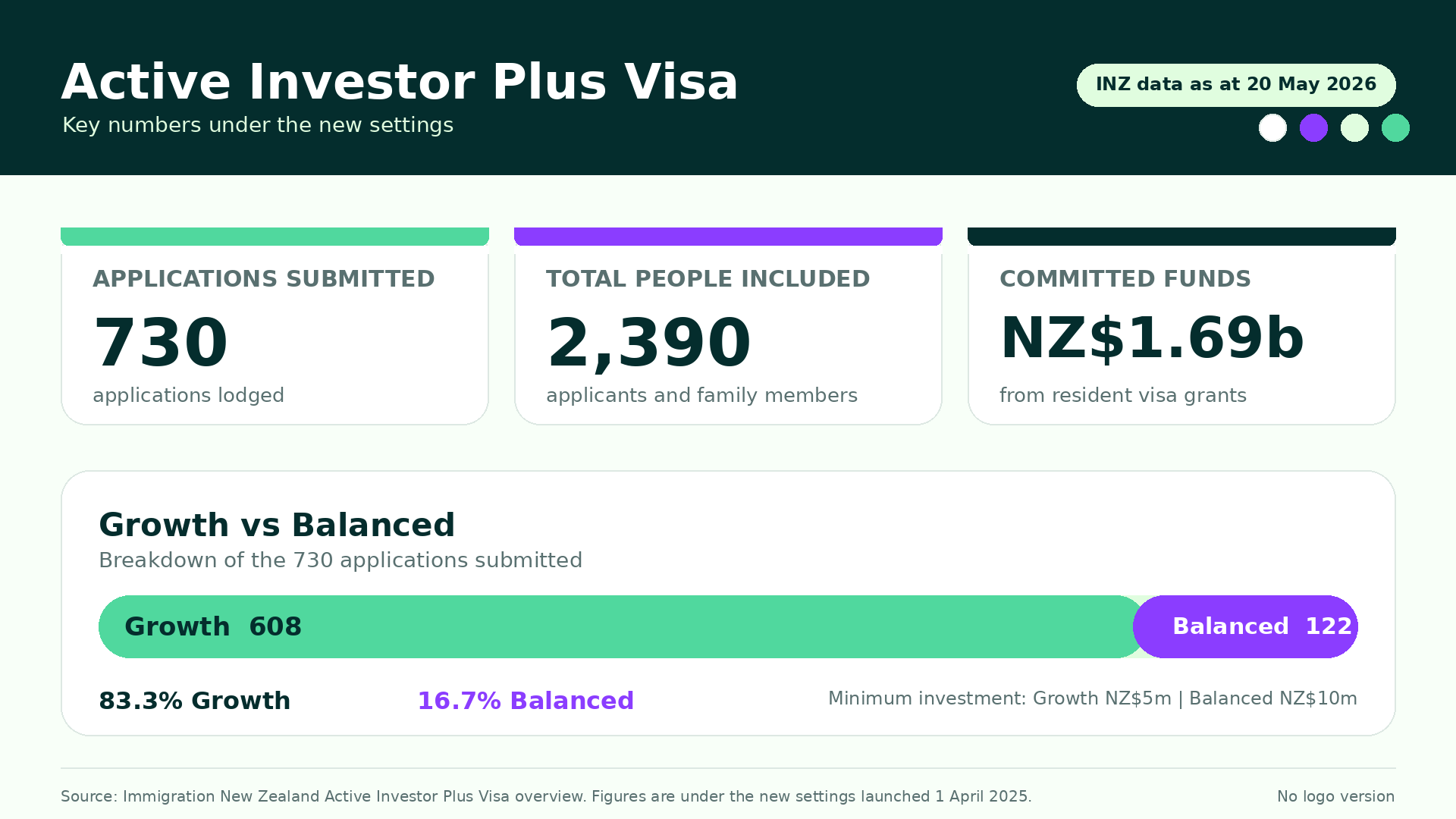
As of late May, the Active Investor Visa (sometimes referred to as the Golden Visa) has produced a significant level of interest, with a large proportion of the applications coming from the US or Europe.
While the funds committed sits at $1.69 billion the total amount pledged through the 730 applications, that will eventually find its way in to the economy is a shade over $4.0 billion.
That is a pretty amazing result in just over a year of running this category and the signs are that interest is remaining at pretty steady levels. As the world becomes more complex and in many ways unstable, there are those with substantial wealth, looking for a safe haven.
In some ways, that is one of the concerns with this policy, in that it was delivered only a few months after the last US elections, when a number of citizens of that country were looking for an exit strategy. Since then, that motivation has been fuelled by geopolitical events, leading even more people (from both sides of the US political spectrum) to look for an insurance policy offshore - the question however is whether the demand, not just from the US but elsewhere continues, should the world settle back in to a state of calm.
There is also the tail-end of the investment program to consider and how this current cohort of applicants feel about that investment decision when their three or five year investment period ends. With the vast majority of applicants going in to the Growth category, where investments have a higher level of risk, and in some cases much lower liquidity, the real test of this policy will be their sentiment at the end of the investment term.
For now however, what we have is a workable, sensible and pragmatic way of attracting investment in to New Zealand and along with that investment, we are also bringing in highly connected, experienced and entrepreneurial people, who are likely to invest far more than the visa requires.
The Program
At its simplest, the Active Investor Plus Visa is New Zealand’s residence-by-investment pathway. That phrase tends to make people twitch slightly, but stripped of the politics, the idea is pretty straightforward: an applicant commits a significant amount of lawful capital into acceptable New Zealand investments, keeps it there for the required period, spends a minimum amount of time in New Zealand, and in return has a pathway to residence and ultimately permanent residence. Of course, this being immigration policy, “straightforward” does not mean “simple”.

How It Works
The Active Investor Visa has two pathways, depending on how much you can invest. So far, the Growth Category has proven the most popular.
There are two main categories: Growth and Balanced. Same visa family, very different personalities. The Growth Category is the more active, higher-impact option. It requires a minimum investment of NZD $5 million, held for 36 months. The acceptable investments are more targeted: direct investments, approved managed funds, and philanthropy, although philanthropy is capped at 20% of the total investment. It also has the lightest physical presence requirement, with only 21 days in New Zealand required during the three-year investment period. In other words, this is the category for investors willing to place money into New Zealand businesses, funds and opportunities that are intended to do a little more than sit quietly in the corner looking respectable.
The Balanced Category requires a larger minimum investment of NZD $10 million, held for 60 months. It allows a wider range of investments, including direct investments, managed funds, listed equities, philanthropy, bonds and certain property developments. The trade-off is time: both in terms of the five-year investment period, and the requirement to spend 105 days in New Zealand during that period. That time requirement can be reduced if additional funds are placed into acceptable Growth category investments, but again, this has to be structured properly from the outset.
The process usually looks something like this: first, determine which category actually fits the investor, their appetite for risk, and their wider plans for New Zealand. Then comes the evidence: identity, health, character, source of funds, ownership of funds, and the all-important proof that the money was earned or acquired lawfully. Once Immigration New Zealand approves the application in principle, the investor generally has six months to transfer and invest the nominated funds in New Zealand. This is where the process can become a little less glossy-brochure and a little more forensic-accounting-with-a-side-salad-of-immigration-policy.
The funds transferred must generally be the same funds nominated in the application, or funds received from selling the nominated assets. They must move through the international banking system, and the paper trail needs to be clear. Immigration New Zealand will want to see where the money came from, where it went, how it moved, and whether the funds can be traced at every stage. If there are gaps, unexplained transfers, third-party detours, or a trail that looks like it was assembled during a power cut, that can create real problems.
Then, even once the money lands in New Zealand, the investor is not finished. The investment must remain acceptable for the full investment period. If investments are changed, sold, returned or restructured, there are rules about reinvestment, timeframes and evidence. Growth investors must keep at least NZD $5 million invested for 36 months and provide evidence at the required checkpoints. Balanced investors must keep at least NZD $10 million invested for 60 months and do the same. So while the visa is attractive, it is not a “send money, get residence, disappear into the sunset” arrangement. Immigration New Zealand remains interested - inconveniently so, one might say - until the conditions have been met.
The key point is that the Active Investor Plus Visa is not just an immigration application, it is an immigration, investment, banking, tax, timing and evidence exercise all rolled into one. That does not make it a bad policy. It does mean investors should treat it with the seriousness it deserves.
The Commentary
As with any investor visa, the Active Investor Plus category attracts strong views. That is hardly surprising. Any policy that allows wealthy migrants to secure residence through investment is going to raise eyebrows, and in some cases, blood pressure.
The criticism is easy enough to understand, as New Zealanders are rightly sensitive to questions of fairness. When skilled migrants wait years, employers battle labour shortages, and families navigate complex residence settings, a visa pathway based on millions of dollars can feel uncomfortable for some.

Everyone Is A Critic
The Active Investor Visa has drawn plenty of commentary (good and bad), but at the end of the day, it is a policy delivering significant investment in to New Zealand.
There is also the familiar concern that New Zealand becomes a convenient bolt-hole for the wealthy rather than a country people actively contribute to. Add in the phrase “golden visa” and suddenly everyone is picturing billionaires buying bunkers, vineyards and possibly a spare mountain.
There are also more practical concerns. Not every dollar of investment automatically creates jobs. Not every investor brings networks, expertise or long-term commitment. Some investments are more passive than others. And when property is involved, even indirectly or in limited forms, the public debate can become lively. But the other side of the argument is also strong, and probably stronger in the current climate.
New Zealand needs capital. We are a small, remote economy with ambitious businesses, under-developed capital markets, infrastructure needs, and plenty of good ideas that could use more air-time. The right investor brings more than money - they can bring commercial experience, international connections, access to markets, governance skills and confidence. That is precisely what the redesigned policy is trying to encourage: investment that is not just parked here, but put to work here.
The numbers also tell their own story. Under the previous settings, between September 2022 and 31 March 2025, Immigration New Zealand received only 115 applications. Under the new settings introduced from 1 April 2025, INZ had received 730 applications by 20 May 2026, representing a potential minimum investment of $4.26 billion. Of those, 599 had already been approved in principle, and 288 applicants had been granted resident visas, with committed investment of around $1.69 billion into New Zealand’s economy. That is not a minor tweak. That is a policy doing what it was designed to do.
Is the policy perfect? No. Immigration policies rarely are. They tend to be assembled by committees, interpreted by officials, and then tested by real life - which is where the wheels can occasionally wobble. But is it better than what came before? Yes. The previous version was, to put it gently, a lemon, rolled out by politicians with no real understanding of how the investor migrant market works. The refreshed Active Investor Plus Visa is clearer, more attractive, and better aligned with what New Zealand actually needs: serious investors, lawful funds, real economic engagement and a pathway that makes sense commercially as well as politically.
The good outweighs the bad because this is not simply about letting wealthy people in. Done properly, it is about attracting people who can help New Zealand businesses grow, connect and compete. And frankly, if we can bring in capital, talent and global networks while maintaining proper checks and balances, then we should be mature enough to say that is a good thing.
The Future of the Active Investor Visa
The Active Investor Plus Visa is, in its current form, one of the more attractive residence pathways New Zealand has available. It is clearer than the previous version, more commercially realistic, and far better aligned with what New Zealand says it wants: serious capital, active investment, and people who can contribute more than just a tidy bank balance. There will always be debate about fairness, economic impact, and whether the settings are too generous, too restrictive, or somehow both at the same time - a very New Zealand policy achievement.
But the important point is this: the current settings are working. They have revived interest, brought investors back to the table, and given New Zealand a much more competitive offering in a global market where capital and talent can choose where they go.
The future of the policy will be interesting. If the current momentum continues, we may well see further refinement over time - perhaps more emphasis on productive investment, clearer pathways for high-growth sectors, or adjustments designed to make the process smoother without weakening the checks and balances. Immigration policy is never frozen in time. It moves, sometimes elegantly, sometimes like a shopping trolley with one bad wheel.
For now, though, investors should focus on the opportunity in front of them. The door is open, the settings are attractive, and New Zealand is actively signalling that it wants the right investors to be part of its future.
At Turner Hopkins Immigration Services, we work with investors to understand the visa requirements, choose the right category, map the evidence and transfer process, and coordinate the immigration strategy alongside financial, banking and tax advisers. So, if New Zealand is part of your future planning - as a home, a safe harbour, a business base, or a long-term family option - now is the time to get proper advice.
This policy may evolve, because good, attractive policies usually do. But for serious investors, the current message is clear enough - New Zealand is open for investment. Just make sure you arrive with the right plan, the right paperwork, and a clear understanding of the process involved.
Until next week!